

For most people, work takes up more of the week than anything else, and for anyone on a rota it decides when they sleep, when they see their family and whether they get a weekend. Extra hours are always on offer: an open shift to pick up, a colleague who needs a swap, a message from the manager on a day off. Saying yes is easy, and each yes seems reasonable on its own. Over a few weeks, the hours add up and the rest between them gets shorter.
Fatigue and burnout aren’t the same thing, but they’re close neighbours. The World Health Organization describes burnout as “a syndrome conceptualized as resulting from chronic workplace stress that has not been successfully managed”, with exhaustion, growing distance from the job and feeling less able to do it. Long hours without enough rest are one of the ways that stress builds. It isn’t classed as a medical condition, but it’s recognised as a real effect of work. And work-related stress is common. In Great Britain in 2024/25, the UK’s Health and Safety Executive (HSE) estimates that 964,000 workers had work-related stress, depression or anxiety. That’s 52% of all work-related ill health and 22.1 million working days lost, more than any other cause. The rate in health and social work, where rotas are everywhere, is well above average.
A rota can’t fix workload or a difficult job. But it is the part of someone’s working life an employer controls most directly, and a tiring one is easy to build without noticing. Nobody sets out to give someone a fourth night shift in a row, an early start the morning after a late, or six weeks without a free weekend. When you’re filling gaps under pressure, those patterns are easy to miss, and the person working the shifts is the first to feel them.
So we’ve added a new feature to RotaTiger, for companies in the UK and the US: fatigue checks, built on the UK’s best-known shift-work guidance, from HSE. Turn them on and every shift you plan is checked against it, and against the legal rest limits, as you plan it. You see the problem on the rota before it’s published, with a plain explanation of what to change.
Fatigue checks are completely optional: they stay off until an admin turns them on, and can be turned off again at any time. They aren’t an add-on either. Like every RotaTiger feature, they’re included in the one price per person, with nothing extra to pay.
What HSE says about fatigue
The Health and Safety Executive’s fatigue guidance describes fatigue as “a decline in mental and/or physical performance that results from prolonged exertion, sleep loss and/or disruption of the internal clock”. Its effects include slower reactions, memory lapses and underestimating risk, and it “can lead to errors and accidents, ill-health and injury, and reduced productivity”. HSE also points to fatigue as a root cause in major accidents, including the Herald of Free Enterprise and Clapham Junction.
Three of its findings shape how RotaTiger works:
- The risk is in the pattern. Accidents and injuries “have been found to be higher on night shifts, after a succession of shifts, when shifts are long and when there are inadequate breaks”. So RotaTiger looks at runs of shifts and the rest between them, not just one shift at a time.
- The law isn’t enough on its own. HSE says that “compliance with the Working Time Regulations alone is insufficient to manage the risks of fatigue”. So fatigue checks go further than the legal minimums, which RotaTiger checks anyway.
- People’s own choices can add to it. The duty to manage fatigue is the employer’s, “irrespective of any individual’s willingness to work extra hours”, and HSE notes that problems with overtime and shift-swapping “may indicate inadequate resource allocation and staffing levels”. So RotaTiger checks extra shifts and swaps too, and shows managers where the pressure builds up.
The same story in the US
US guidance reaches the same conclusions. The Occupational Safety and Health Administration (OSHA) says that “accident and injury rates are 18% greater during evening shifts and 30% greater during night shifts when compared to day shifts”, and that “working 12 hours per day is associated with a 37% increased risk of injury”. It links fatigue to depression, heart disease and sleep disorders, and asks employers to look at “workload, work hours, understaffing and worker absences” and to arrange schedules “to allow frequent opportunities for rest breaks and nighttime sleep”. The National Institute for Occupational Safety and Health (NIOSH) adds that fatigue comes from “nonstandard schedules which disrupt or shorten sleep”, and that it slows reactions and impairs judgement.
What the US doesn’t have is a general federal limit for most adult workers. Under the Fair Labor Standards Act, “there is no limit on the number of hours employees 16 years or older may work in any workweek”; it only requires overtime pay after 40 hours. Limits exist for some jobs, such as pilots, truck drivers and rail workers, and some states restrict mandatory overtime for nurses, but most rotas have no federal benchmark. State and local rules vary, so check the ones where you are.
That’s where HSE’s guidance helps on both sides of the Atlantic. OSHA and NIOSH say allow rest and sleep; HSE turns that into numbers you can plan against: how many days, nights and long shifts in a row, how many days off after them, and how much sleep between days and nights. RotaTiger uses HSE’s numbers for everyone, and says so on every warning, so a US manager knows exactly where a limit comes from.
How RotaTiger puts HSE’s advice into practice
HSE’s good practice guidelines, from its guidance HSG256, give goals to aim for. They’re UK guidance, and RotaTiger uses them as the yardstick for every company. Here’s each one and what RotaTiger does with it. Every limit can be changed in Settings; these are the defaults.
| HSE’s guidance | What RotaTiger does |
|---|---|
| Limit consecutive work days to a maximum of 5 to 7 | Warns after 6 days in a row |
| Restrict long shifts, nights and early starts to 2 or 3 in a row | Warns after 3 in a row, then expects at least 2 days off. The morning after a last night shift isn’t counted as a day off |
| Allow 2 nights’ full sleep when switching between days and nights | Warns when someone switches without it |
| Adopt forward-rotating shifts | Warns when shifts rotate backwards (a late, then an early) |
| Limit shifts to 12 hours, or 8 hours for night shifts or demanding, safety-critical work | Treats 12 hours as a long shift and flags nights over 8 hours. If you say the work is demanding or safety-critical, the set-up suggests treating 9 hours as long |
| Avoid early morning starts | Flags starts before 07:00. As it’s a problem with the shift, not the person, it shows under shift design, to fix in your staffing needs |
| Build regular free weekends into the schedule | Warns when someone hasn’t had a weekend off in 4 weeks |
| Encourage regular breaks | Checks the break rules you set, such as a break on shifts over 6 hours |
| Avoid permanent night shifts | No separate check: the Fatigue screen shows how many nights each person is doing |
| Set limits on overtime and shift-swapping | Staff see fatigue and rest warnings before they take an extra shift or agree a swap, and managers see the same warnings |
| Risk assess changes to working hours | Not automatic: the Fatigue screen and its CSV export give you the patterns to review |
Split shifts are checked too, unless you use them on purpose.
For UK companies, whether fatigue checks are on or not, RotaTiger always checks the legal minimums under the Working Time Regulations: 11 hours between shifts, 24 hours off every week (or 48 hours a fortnight), and an average of no more than 8 hours’ work in 24 for night workers, over 17 weeks. These are the general rules: some jobs have exceptions or compensatory rest instead, and some night work has a stricter limit. RotaTiger warns on the general rules, so check GOV.UK’s guidance on rest breaks and night working hours if they apply to you.
Set up in three questions
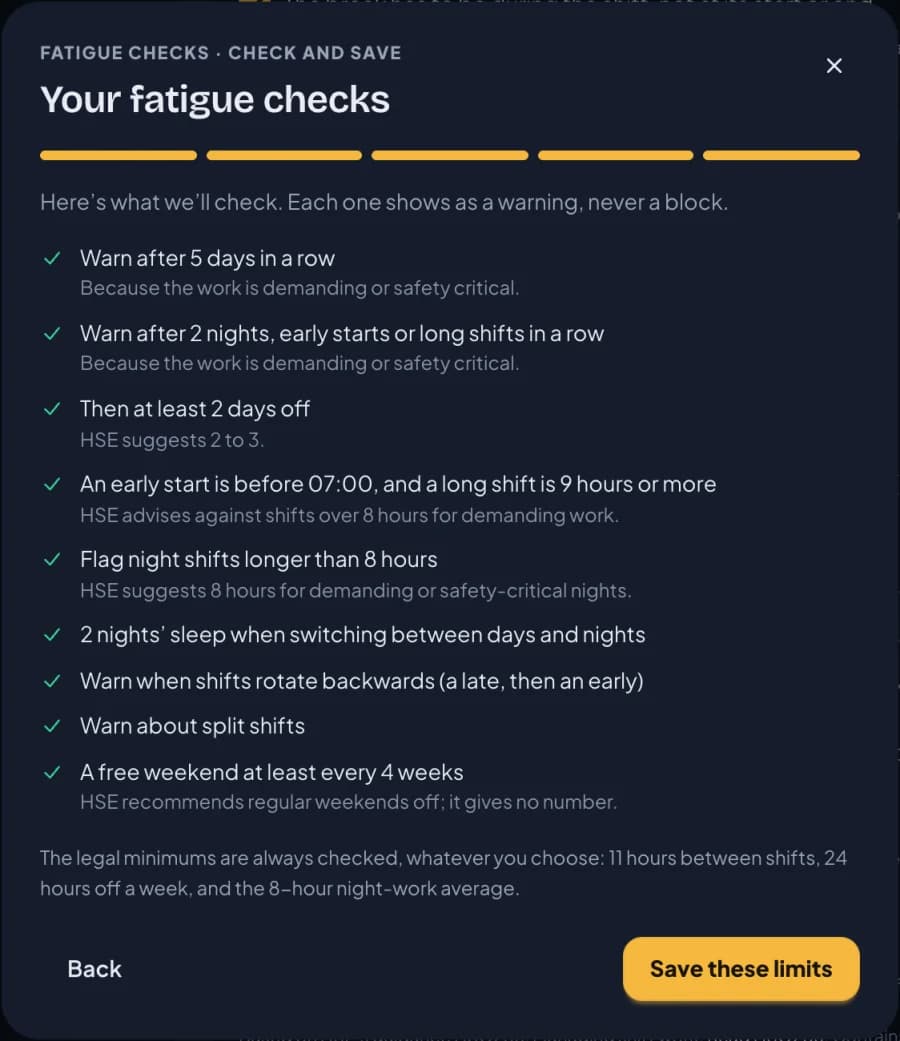
You don’t need to be a shift-work expert to get the limits right. When you turn fatigue checks on, RotaTiger asks three questions:
- Is the work demanding or safety-critical (or you’re not sure)?
- Do some people only work weekends?
- Do you use split shifts on purpose?
It then suggests limits to match, tells you why for each one, and shows you HSE’s suggested range beside it. You can save them as they are, or change any of them. Where HSE gives a range, the defaults sit within it, so if you’d rather skip the questions, you’re starting somewhere sensible.
Warnings where you plan, never a block
Once fatigue checks are on, a ⚠ shows on any shift that breaks a limit, and a FATIGUE badge appears beside the person on the rota, in red if a legal limit is involved. Hover or tap for the reason in plain words, for example: “Makes 4 nights in a row (Mon 16 Nov to Thu 19 Nov); UK guidance (HSE) suggests 2–3, the company’s limit is 3.”
They’re warnings, not blocks. Real rotas sometimes need a fourth night, and you know your team, so nothing stops you publishing. If you do keep a shift that breaks a limit, you’ve seen the reason first.
Auto-fill that thinks about rest
RotaTiger’s auto-fill builds a rota from your staffing needs and each person’s availability and contracted hours. With fatigue checks on, it won’t create a shift that would cause a warning, and when more than one person could take a shift, it prefers whoever is furthest from a limit.
The Fatigue screen: whose shifts trigger the most warnings, and why
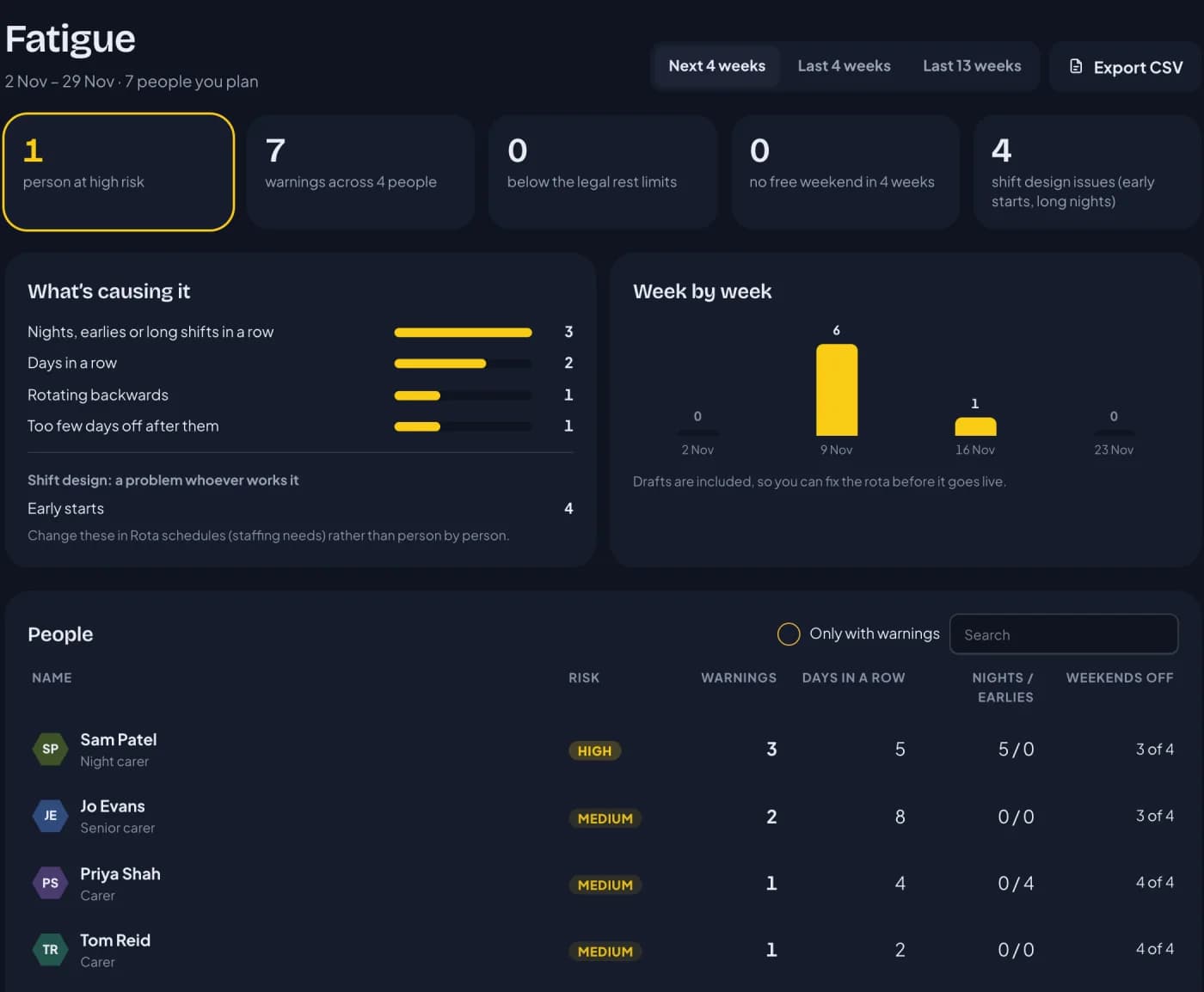
The new Fatigue screen, in the Planning menu, brings it all together for the next 4 weeks, the last 4, or the last 13:
- Who’s affected: each person rated high, medium or low on their planned shift pattern (not their health), with their warnings, their longest run of working days, how many nights and early starts they’re doing, and how many weekends they’ve had off.
- What’s causing it: which checks are firing most, so you can see whether the problem is a person’s pattern or the whole rota.
- Week by week: where the pressure falls, with drafts included, so you can fix next week before it goes live.
- Shift design: some problems belong to the shift, not the person. A 06:00 start is an early start whoever works it, so RotaTiger flags it once, as something to change in your staffing needs, rather than against everyone who covers it.
- Each person’s detail: their shifts on a strip, with every warning explained and a link straight to that week on the rota.
Every term has a (?) beside it explaining what it means and what you can do about it. And it all exports to CSV, to keep a record of the patterns and warnings you’ve reviewed.
Your team sees it too
A tiring run often starts after the rota is published, when someone picks up an extra shift or swaps with a colleague.
So when someone goes to take an open shift or agree a swap, RotaTiger tells them first if it would break a fatigue or rest limit. They can still go ahead (it’s their choice), and their manager sees the same warning when they choose who gets a shift or approve the swap. It’s on the web now, and comes to the RotaTiger apps in their next update.
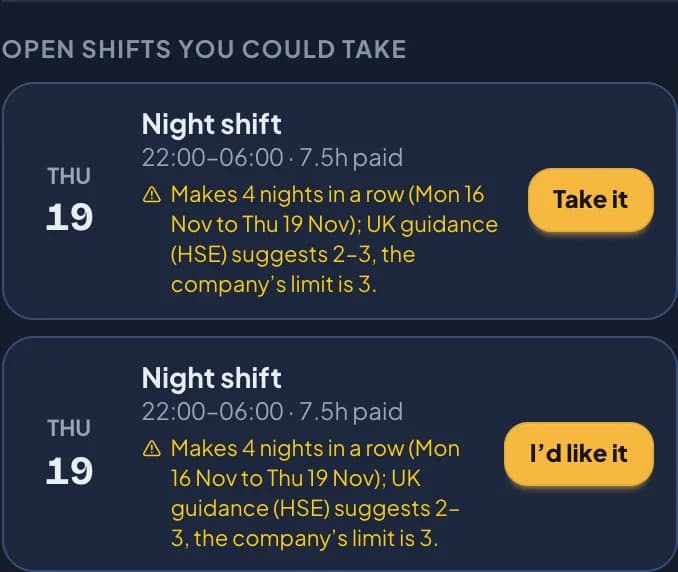
What staff don’t see is anyone’s fatigue rating, including their own. Ratings are a planning tool for managers and HR, not a score for people to worry about.
Rest, and mental health
HSE lists ill-health among fatigue’s effects, and counts stress, depression and anxiety together as the biggest cause of work-related ill health. Fatigue checks don’t diagnose anything, and they won’t fix workload or a difficult job. What they do is help you build rotas that leave room to recover: proper breaks between runs of nights, days off that really are days off, and weekends that come round often enough.
A few other parts of RotaTiger help here too:
- Fewer surprises. Staff see their rota ahead and are told when it changes, so they can plan their lives around it.
- Private sickness. When someone reports in sick, including for their mental health, the reason is kept private: only their manager and HR see it, and teammates see only “Away”.
- Warnings where people decide. Staff hear about a tiring run before they say yes to an extra shift, rather than finding out halfway through it.
If you’re worried about someone, or about yourself, talk to them, and point them to support. In the UK, the NHS’s Every Mind Matters has practical advice, HSE has guidance on work-related stress for employers, and Samaritans are there day and night on 116 123. In the US, the 988 Suicide & Crisis Lifeline is free and confidential, any time: call or text 988.
Ask your AI assistant
RotaTiger also works in AI assistants such as Claude and ChatGPT. Managers can ask, “Who on my team is most at risk of fatigue next month?” and get the same answer as the Fatigue screen. Staff asking about open shifts hear the same warnings they’d see on screen. (More about AI assistants in RotaTiger.)
Why it’s worth turning on
- Look after your people. You see long runs of nights, short rest and missing weekends while you can still change them, before they turn into exhaustion.
- Lower the risk of mistakes and accidents. HSE links fatigue to slower reactions and more errors, especially on nights and long shifts.
- See rest-limit warnings as you plan. For UK companies, the Working Time Regulations checks run on every shift, even with fatigue checks off.
- Keep a record. Use the Fatigue screen and its CSV export when you review how you manage shift-work fatigue.
Get started
Fatigue checks are optional and off until you turn them on. They’re included in RotaTiger’s single price per person, like every other feature, for companies in the UK and the US.
- Open Settings and find Fatigue checks.
- Choose Set up with 3 questions, or set the limits yourself.
- Plan as usual. Warnings appear as you go, and the Fatigue screen shows the bigger picture.
On this site, Fatigue checks explains what each check does and how to set them up. Inside RotaTiger, the Help page has a Fatigue checks guide, and every check on the Fatigue screen has a (?) explaining what it means and what to do about it.